Credence · The AI reserving analyst
Hand it your book.
It thinks like your
best actuary.
Give Credence a loss triangle and it reads it the way a senior reviewer would — it spots what a junior would miss, names the phenomenon, quantifies the reserve impact, and takes your questions. The judgment is AI; the arithmetic is a deterministic engine; a guard makes sure it never invents a number.
Real reasoning on a real triangle, in seconds. Every figure it cites is checked against the engine — if it can't be traced, it gets flagged.
Not accident-year deterioration — a one-time case-reserve strengthening sitting on the latest diagonal.
The problem
Every reserving review needs a second pair of expert eyes.
There are never enough of them.
The hard part of reserving was never running chain-ladder — software has done that for decades. The hard part is judgment: is this accident year really deteriorating, or did the claims department just re-set its case reserves? Is that jump a trend or a single large loss? Should you trust your own thin data or lean on the industry?
That judgment lives in a handful of senior actuaries, and it doesn't scale. A mid-size carrier has one or two of them; an MGA often has none on staff. So reviews get shallow, second opinions cost $50k–$500k, and the subtle problems get caught late — or not at all.
The reserve number is easy to compute and hard to judge. Credence is a judgment you can summon on demand.

What it does
It reads. It diagnoses. It answers back.
Reads the triangle
Hand it a book — a loss triangle, however it comes. It assembles the development, compares the latest valuation against prior years, and gets its bearings the way an actuary opening a new file would.
Diagnoses like a reviewer
It surfaces the one thing that matters and names it — a calendar-year case-reserve shift, a social-inflation trend, a large-loss outlier, thin-data credibility — with the evidence, and quantifies what it does to your reserve. Not a dashboard: an opinion.
Takes your questions
Interrogate it in plain language — "is that really one-time?", "what would you book?", "what else do you need to see?" — and it reasons back, grounded in the same numbers.
Why you can trust it
An AI that thinks freely — and can't make up a number.
The failure mode of AI in a regulated numbers business is the confident fabrication. Credence is built so that can't happen: the model does the reasoning, but never the arithmetic.
The engine computes; the AI reasons
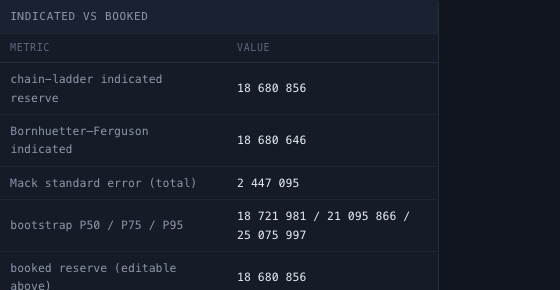
Every reserve figure comes from a deterministic engine — chain-ladder, Bornhuetter–Ferguson, Mack, bootstrap — validated to match the published literature exactly. The AI reads those results and forms the judgment.
- engine matches Mack (1993) to the digit
- same inputs, same numbers, every time
A guard checks every number
Before you ever see the analyst's note, every figure in it is matched back to an engine value. Anything that doesn't trace — a hallucinated number — is flagged, not shown as fact.
- "✓ all figures trace to the engine" on every answer
- fabrication is caught by construction, not by hope
The actuary still signs
Credence is the fast, tireless first reviewer — not the signer. It hands a credentialed actuary a diagnosis and a defensible number; the judgment call and the signature stay human.
- built for the profession where "show your work" is the law
- every claim on this site runs live — go check it

The number guard runs on every diagnosis — here, all 11 figures traced back to the engine.
Why "Credence"
Named for the oldest idea in modern actuarial science.
Z — credibility factor · — your own experience · μ — the collective mean
Credibility theory is the century-old actuarial formula for weighting your own experience against the world's evidence. That is our operating principle, not just our name: the machine brings scale, memory, and speed; the actuary brings judgment and accountability.
Credence is the weighting between them — the AI does the reading and the reasoning, the actuary keeps the pen.
Founding partners
Point it at your real book.
The public demo runs on prepared books. The next step is running the analyst on your triangles — and shaping how it reasons around the lines and quirks of your book. We're taking three founding partners: US P&C MGAs or mutuals whose reserving reviews are stretched thin.
Founding partners get: the analyst tuned to their book, permanent founding pricing, and a direct line to the people writing the code.
FOUNDING-PARTNER PROGRAM · 3 SLOTS · US P&C
Start with a working session: bring a hard book and a hard question, and watch the analyst work through it with you.